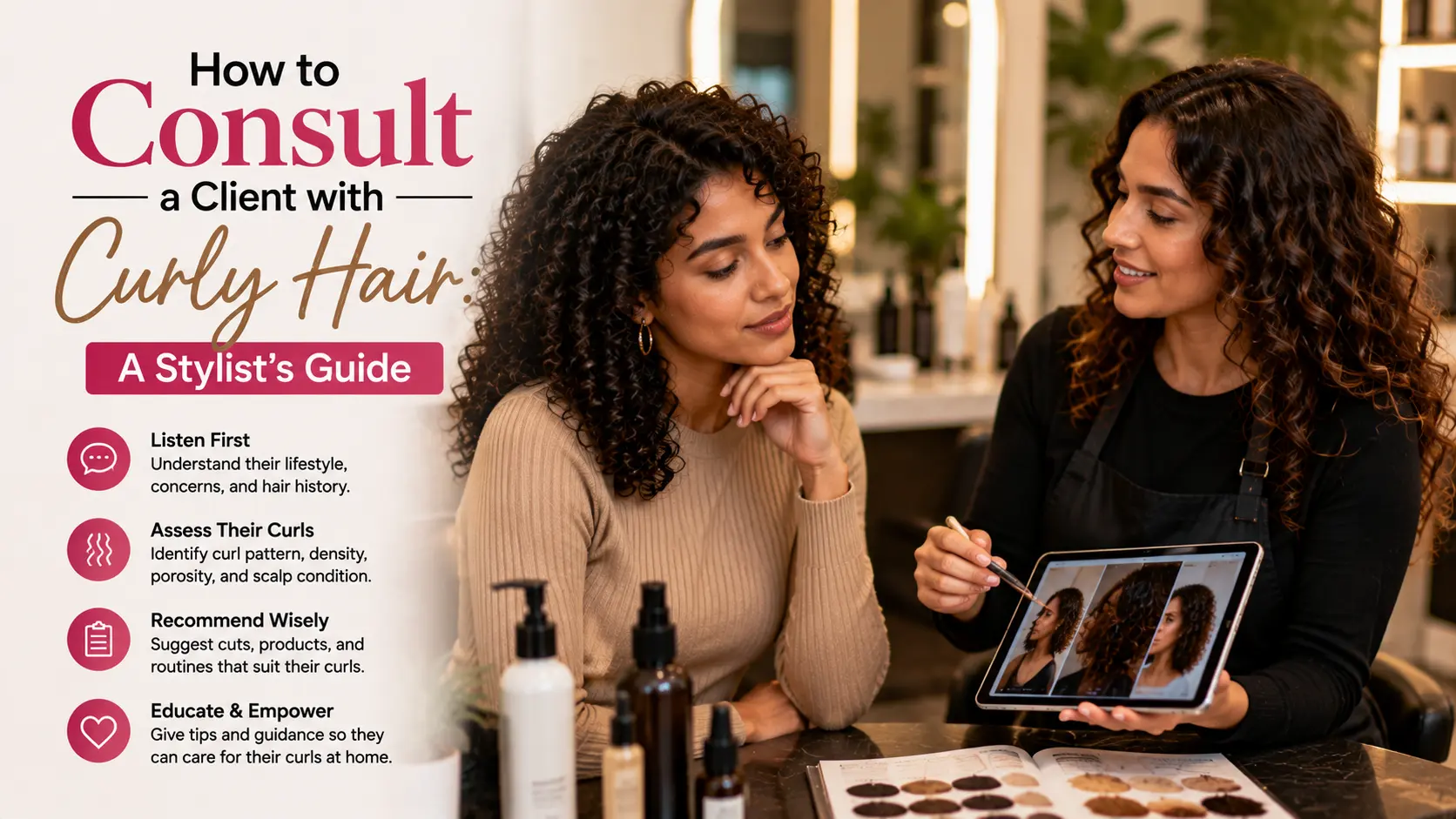
Curly hair consultation: Best Stylist’s Guide
Introduction: The Most Critical 15 Minutes in the Salon
In the professional beauty world, a haircut actually begins long before the first snip of the scissors. It begins the moment the client sits in your chair and you start the dialogue. For clients with straight hair, a consultation might be a simple two-minute exchange. However, for the millions of individuals with natural waves, curls, and coils, the Curly hair consultation is a high-stakes emotional and technical negotiation. In 2026, as the demand for natural texture services hits an all-time high, your ability to conduct this consultation effectively is what will define your reputation as an elite stylist.
Let’s be honest: most curly-haired clients walk into a salon with “Salon Trauma.” They have spent years being told their hair is “difficult,” having it thinned out with the wrong shears, or watching it shrink into a “triangle head” because of a poor wet cut. When a client books a session for curly hair cuts, they aren’t just looking for shorter hair; they are looking for someone who finally understands them. A masterful Curly hair consultation is the foundation of client retention. If you win their trust in the first 15 minutes, you have a client for life.
In this 1600-word hair stylist training guide, we will deconstruct the anatomy of a perfect consultation. We will explore the diagnostic questions you must ask, the physical hair tests you must perform, and how the “Stylelink Ecosystem”—utilizing the Stylelink App for talent and Lokaci Pro for data—is the only way to professionalize texture services in a modern salon. Whether you are an owner looking to train your team or a stylist aiming for the top tier, it is time to master the art of the consult.
Industry Standard: Flagship establishments like The Salon Company have made a 15-minute Curly hair consultation mandatory for every new client. (Pro Tip: If you are an owner struggling to find staff with these advanced diagnostic skills, the Stylelink app allows you to filter and hire specialists who are already certified in texture management).
Phase 1: The Visual & Tactile Diagnostic
A professional Curly hair consultation must always begin with the hair in its natural, dry state. If the client arrives with their hair tied back or soaking wet, you cannot perform an accurate assessment. You need to see the “gravity” of the curls.
1. Identifying the Multi-Texture Pattern
Almost no curly client has a uniform pattern across their entire head. They might have 3A ringlets at the nape of the neck but 2C waves at the crown. During the Curly hair consultation, you must map these zones. This mapping determines where you will place layers to prevent “shelving” and ensure the silhouette is balanced.
2. The Porosity Test (The “Thirst” Check)
Run your fingers up a strand of hair. If it feels rough, the hair is high-porosity and will soak up product like a sponge but lose moisture just as fast. If it feels smooth, it is low-porosity. Understanding porosity during the Curly hair consultation allows you to prescribe the correct home-care routine, which is vital for long-term client retention. High-porosity hair needs heavy sealants, while low-porosity hair needs lightweight, water-based humectants.
3. Elasticity & The “Spring Factor”
Pull a single curl and watch it snap back. This is the “Spring Factor.” This is the most dangerous part of the service for an untrained stylist. If you don’t account for the recoil during the Curly hair consultation, you will cut the hair too short. Elite stylists at The Salon Company use the recoil measurement to tell the client exactly where the hair will sit once it is dry.
Phase 2: The Lifestyle Audit—Asking the Right Questions
Great curly hair cuts fail if they don’t fit the client’s morning routine. Your hair stylist training should include these four non-negotiable questions during the Curly hair consultation:
- “How many days a week do you wash your hair?” If they wash daily, they are likely stripping their curls of natural oils. If they wash once a week, you need to provide a cut that remains structured even on “Day 6” hair.
- “What is your ‘Time-to-Mirror’ limit?” Do they have 45 minutes to diffuse curly hair, or do they need a “wash-and-go” style? This dictates the complexity of the layering you provide.
- “How do you sleep?” Do they use a silk pillowcase or a bonnet? If not, their curls will frizz regardless of how good your cut is. Part of a Curly hair consultation is educating the client on nighttime preservation.
- “What is your ‘Grip’ preference?” Do they like their hair to feel soft and touchable, or do they prefer a strong-hold gel cast that lasts for days?
Phase 3: Managing the “Shrinkage” Conversation
This is where 90% of salon complaints originate. A client asks for “two inches off,” but after drying, the hair looks four inches shorter. In your Curly hair consultation, you must use visual aids. Show the client the difference between stretched length and resting length. Use your fingers to show where the hair will bounce up to. At The Salon Company, stylists are trained to always under-cut initially, allowing for more to be taken off after the hair is diffused.
Leveraging Lokaci Pro for Client Retention
A Curly hair consultation shouldn’t just exist in the air; it should be documented. This is the difference between a “local parlour” and a “modern hair business.” Lokaci Pro Salon Software allows you to digitize the consultation process:
- Digital Style Notes: Store photos of the client’s hair from different angles. Log their porosity and elasticity scores. The next time they visit, any stylist in the salon can see exactly what was discussed, ensuring 100% consistency.
- Chemical History: Curls are easily damaged by color. Lokaci Pro tracks every chemical service, ensuring that during the Curly hair consultation, you are aware of hidden “bleach bands” that could affect the curl pattern.
- Automated Education: Use Lokaci Pro to send a WhatsApp message to the client immediately after the consult with a summary of the hair care tips you provided. This “Expert Nudge” drastically increases client retention because the client feels you are genuinely invested in their hair journey.
Phase 4: The Product Prescription via Zubito
The final stage of the Curly hair consultation is the prescription. You have diagnosed the hair; now you must provide the cure. Most curly hair failures happen because the client uses the wrong shampoo at home. As a professional, it is your duty to explain why they must switch to sulfate-free and silicone-free products.
Through the Zubito supply chain integrated into Lokaci Pro, your salon can stock authentic, global texture brands. During the Curly hair consultation, physically put the bottles in the client’s hand. Explain how to use them. Teach them the “Praying Hands” or “Scrunch to Condish” method. This education transforms you from a “haircutter” into a “Curl Consultant,” allowing you to charge higher service fees.
The Professional Advantage: Why the Stylelink app is Essential for Owners
If you own a salon and want to tap into the lucrative curly market, you cannot rely on average staff. You need stylists who have undergone specific hair stylist training for texture. Finding these needles in a haystack used to be difficult.
The Stylelink App has revolutionized recruitment. Owners can now filter for “Texture Specialists” and “Dry-Cut Certified” professionals. You can view their digital resumes—hosted on Stylelink—which feature visual proof of their curly hair cuts. By hiring specialists who master the Curly hair consultation, you instantly elevate your brand to the level of The Salon Company.
Top 3 Mistakes to Avoid in a Curly Hair Consultation
Even seasoned professionals can fall into these traps. Avoid these to maintain high client retention:
- The “Comb-Through” Error: Never brush or comb dry curls at the start of a Curly hair consultation. It creates a frizzy cloud that hides the natural curl clumps. Always manipulate curls gently with your fingers or a wide-tooth comb only when saturated with water.
- Over-Promising: If a client has heat-damaged Type 4 hair and wants “shiny Type 3 ringlets,” you must be honest. Curls cannot be changed, only enhanced. Explain the “Transition Phase” and set a 6-month goal for hair health.
- Ignoring the Crown: Most people have flatter hair at the crown. If you don’t discuss “internal layering” to create height during the Curly hair consultation, the client will leave feeling their hair looks “heavy” and flat.
Conclusion: Become the Authority in Texture
The mastery of the Curly hair consultation is the single most important hair stylist skills you can acquire in 2026. It bridges the gap between technical execution and psychological safety. When you can look at a client’s hair, diagnose its porosity, predict its shrinkage, and document its history via Lokaci Pro, you are no longer just a stylist—you are an expert authority.
Stop giving generic haircuts. Experience the power of specialized texture care by following the clinical path set by The Salon Company. And for the ambitious professionals ready to lead this movement, download the Stylelink App today to find the most prestigious salon jobs in the industry. Your future in texture is waiting—start with a better conversation.
Frequently Asked Questions (FAQs)
Q1: Why should I cut curly hair dry instead of wet?
As taught in elite hair stylist training, curls look different wet than dry. Dry cutting allows you to see the exact length and shape in real-time, accounting for the unique “recoil” of every ringlet, which is impossible during a wet cut.
Q2: How do I handle a client who wants to keep their length but has severe damage?
Use the Curly hair consultation to explain “The Big Chop” vs. “The Slow Transition.” Recommend a “Dusting” (micro-trim) every 4 weeks combined with deep-conditioning spas at The Salon Company to slowly grow out the damage while maintaining the shape.
Q3: Is a specialized consultation more expensive?
Yes. Most high-end salons charge a separate “Consultation Fee” or build it into the higher price of specialized curly hair cuts. Your time, diagnostic expertise, and use of Lokaci Pro are premium services that clients are happy to pay for.
About the Author


