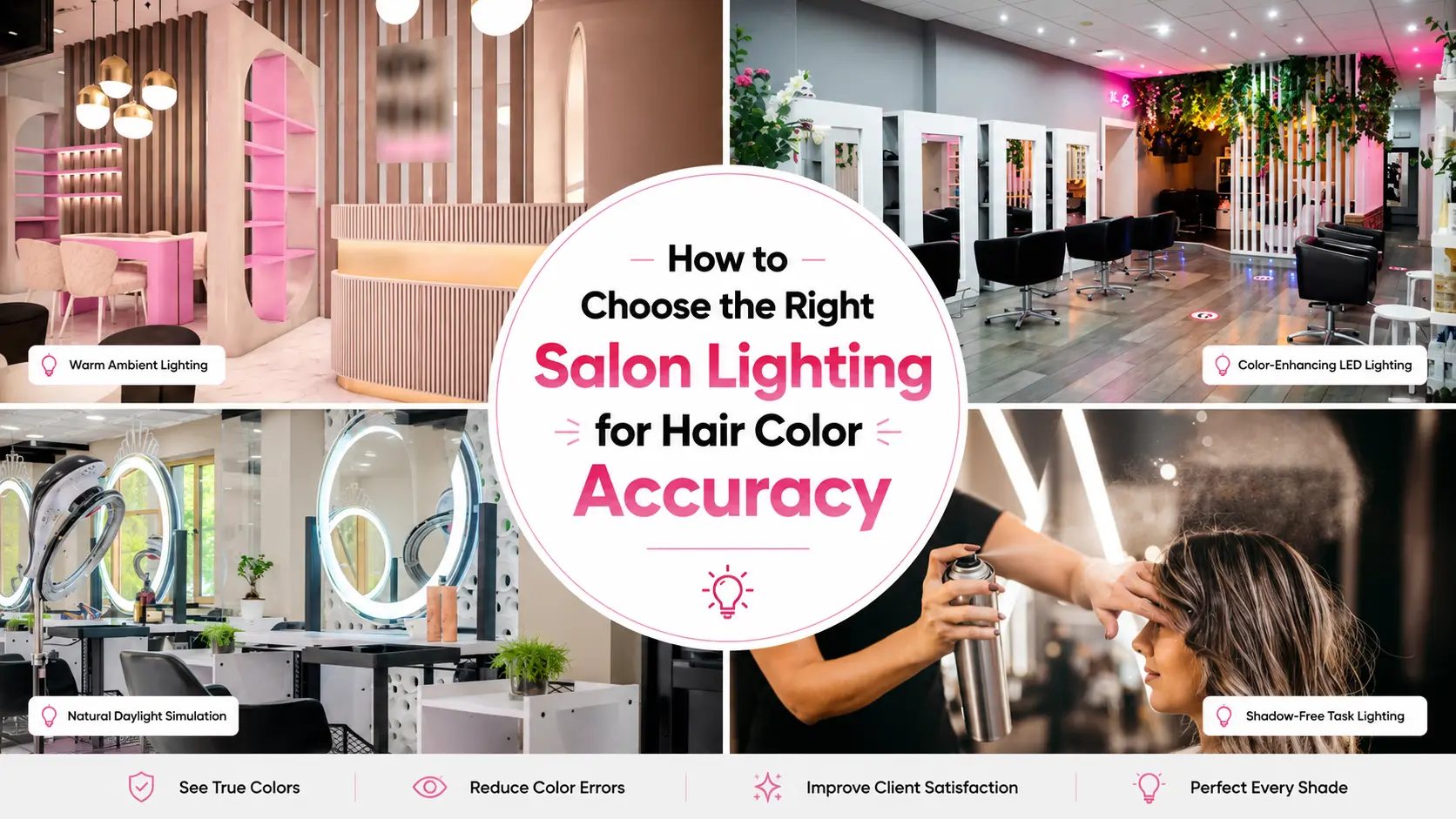
How to Choose the Right Salon Lighting for Hair Color Accuracy
Introduction: The “Parking Lot” Nightmare
Every professional colorist has experienced this nightmare: You spend four hours meticulously crafting a multi-dimensional ash-blonde balayage. Under your station lights, the tone looks cool, creamy, and flawless. The client is thrilled. However, the moment she steps out of the salon and looks in her car’s rearview mirror, she calls you in a panic—her hair looks brassy, orange, or muddy. This isn’t a failure of your chemical formulation; it is a failure of your salon lighting.
In 2026, as the demand for high-precision chemical services like Nanoplastia and advanced color corrections reaches an all-time high, the technical requirements for a hair color station setup have evolved. Lighting is no longer just a part of your salon interior design; it is a clinical tool. If your lighting is inaccurate, your artistry is compromised. Inaccurate lighting leads to redo services, lost revenue, and damaged reputations.
Moreover, in the era of social media dominance, your salon is a content studio. If your salon lighting is poor, your “Before & After” photos will look dull, no matter how good the hair is. In this 1600-word masterclass, we will deconstruct the physics of the Color Rendering Index (CRI), the balance of warm vs cool lights, and how to architect a space that guarantees color accuracy and client satisfaction. It is time to see your business in a whole new light.
Industry Standard: Elite brands like The Salon Company view lighting as a high-performance asset. They utilize specific Kelvin temperatures to ensure that the color mixed in the lab is exactly what the client sees in the mirror. (Pro Tip: For stylists looking to showcase their work in the best light, the Stylelink digital portfolio is the industry’s premier platform).
The Physics of Color Accuracy: CRI and Kelvin
To master salon lighting, you must understand two scientific metrics: The Color Rendering Index (CRI) and Color Temperature (measured in Kelvin). Ignoring these is the #1 mistake in salon decor.
1. CRI (Color Rendering Index)
CRI measures how accurately a light source reveals the true colors of an object compared to natural sunlight. The scale goes from 0 to 100. For a hair color station setup, any light with a CRI below 80 is unacceptable. It will make cool tones look warm and vibrant reds look brown. In 2026, premium salons insist on CRI 90+. This ensures that the microscopic pigments in your hair dye are visible to the naked eye with 100% accuracy.
2. Kelvin (Color Temperature)
This is where the warm vs cool lights debate is settled.
• 2000K – 3000K (Warm): Yellow/Orange light. Great for a cozy waiting area, but terrible for color. It hides brassiness, making it impossible to see if you’ve neutralized the hair properly.
• 5000K – 5500K (Daylight): This is the “Gold Standard” for salon lighting. It mimics high-noon sunlight. It is neutral, revealing both warm and cool tones with clinical honesty.
• 6500K+ (Cool): Blue/Stark light. This makes hair look flat and can make skin look sickly. It is too harsh for client comfort.
Architecting the Perfect Hair Color Station Setup
Your salon lighting strategy must be layered. You cannot rely on a single overhead bulb. To eliminate shadows and reveal the true depth of the hair, you need a three-point lighting system at every station:
- Task Lighting (Overhead): Placed directly above the client’s head. This should be a high-CRI, 5000K LED panel. It provides the intensity needed to see the scalp and the hair cuticle clearly during application.
- Mirror Lighting (Side Illumination): This is the most forgotten part of salon interior design. Placed on either side of the mirror at eye level, these lights fill in the shadows under the client’s eyes and chin. It makes the client look healthy and allows the stylist to see the hair from the sides.
- Ambient Lighting: This is the general salon decor lighting. It should be slightly warmer (around 3500K) to keep the overall atmosphere inviting and relaxing, contrasting with the clinical accuracy of the styling stations.
Warm vs. Cool Lights: Striking the Balance
If your entire salon is “Cool Blue,” it will feel like a hospital. If it is “Warm Orange,” it will feel like a 1970s basement. The secret to great salon lighting is “Zone Balance.”
The Retail & Waiting Zone: Use warm lights (3000K). This creates an immediate “Relaxation Trigger” for the client. It makes your salon decor feel expensive and cozy.
The Color Bar & Station: Use cool-neutral lights (5000K). You need high visibility here. If you mix color under warm lights, you are flying blind. When you work at a brand like The Salon Company, you will notice the stations are “Neutral Islands” in a warm, luxurious room. This is intentional salon interior design.
Business Impact: How Lighting Affects Your Lokaci Pro Metrics
You might wonder how salon lighting connects to your billing software. The connection is direct and financial. By utilizing Lokaci Pro, you can track the impact of your infrastructure upgrades:
- Reducing Redo Services: Every “re-do” costs you double in product and labor. Accurate salon lighting ensures the job is done right the first time. Lokaci Pro helps you track these “Service Corrections,” allowing you to see how better lighting directly lowers your wastage costs.
- Higher Ticket Sizes: When clients look good in the mirror (thanks to side-mirror lighting), they are 40% more likely to say “Yes” to add-on services or premium retail products. Accurate lighting sells results.
- Supply Chain via Zubito: Need to replace those high-CRI bulbs? The Zubito supply marketplace connects you directly with professional lighting manufacturers, ensuring you get authentic, long-lasting hardware at wholesale rates.
Career Spotlight: The Lighting-Aware Colorist via Stylelink
Are you a professional colorist? In 2026, your hair stylist salary is tied to your digital brand. If you cannot take a great photo of your work, you are invisible. Mastering salon lighting for photography is a mandatory skill.
Here is how the Stylelink ecosystem scales your value:
- The Visual Portfolio: Use Stylelink’s Resume & Portfolio Builder. When you upload photos taken under high-CRI salon lighting, the clarity of your work will stand out to premium recruiters at The Salon Company. A photo taken under poor lighting looks like amateur work, no matter the skill level.
- Find Tech-Forward Salons: Download the Stylelink App. You can research salons and see their interiors. Aim to work at establishments that invest in a professional hair color station setup. These salons attract higher-paying clients and offer better career growth.
5 Tips for Styling Station Lighting in 2026
To upgrade your salon decor and accuracy today, implement these five quick changes:
- Avoid Direct Halogens: They produce too much heat and create harsh, “hot spot” glares on the client’s hair. Switch to high-quality LED panels.
- Diffuse the Light: Use frosted lenses or diffusers. Soft, wrapping light reveals the depth of a hair color far better than a sharp beam.
- Neutral Wall Colors: If your walls are bright red or green, they will “bounce” that color onto the client’s hair, making your color work look inaccurate. Stick to neutral whites, greys, or blacks near the color stations.
- The Window Factor: If you have natural windows, great! But remember, sunlight changes throughout the day. You need consistent salon lighting that remains 5000K even when it is raining or night-time.
- Clean Your Fixtures: Dust on bulbs can lower their CRI and brightness by 20%. A simple monthly wipe-down is essential for salon management.
Conclusion: Don’t Leave Your Art in the Dark
In the high-production world of modern beauty, every detail counts. Your salon lighting is the lens through which the world sees your talent. By investing in high-CRI, neutral-temperature LEDs and architecting a clever balance of warm vs cool lights, you protect your revenue, empower your stylists, and guarantee that your clients walk out feeling like celebrities.
Stop guessing your colors. Standardize your excellence today. Upgrade your operational and supply backbone by integrating with Lokaci Pro and Zubito. And for the ambitious artists looking to build a six-figure brand, download the Stylelink App to showcase your work in the perfect light. The future of beauty is brilliant—make sure your salon is leading the way!
Frequently Asked Questions (FAQs)
Q1: Why does hair color look green under certain lights?
This usually happens under old-school fluorescent tubes or low-CRI LED lights that have a high “green/blue peak” in their spectrum. Upgrading to salon lighting with a CRI of 90+ will eliminate this artificial green cast.
Q2: Can I just use “Warm White” bulbs for everything?
No. Warm white bulbs (around 2700K) over-emphasize red and gold tones. You will think you’ve achieved a perfect warm brown, but in daylight, the hair might actually be a muddy neutral. 5000K is the only way to see the truth.
Q3: How much does a professional lighting upgrade cost?
While prices vary, a professional LED panel for a single hair color station setup starts around ₹3,000 to ₹5,000. It is a small investment considering it can prevent thousands of rupees in redo services. You can find verified hardware on the Zubito marketplace.
#Salon lighting #hair color station setup #salon interior design #warm vs cool lights #salon decor #the salon company #stylelink #lokaci pro #beauty tech
About the Author


