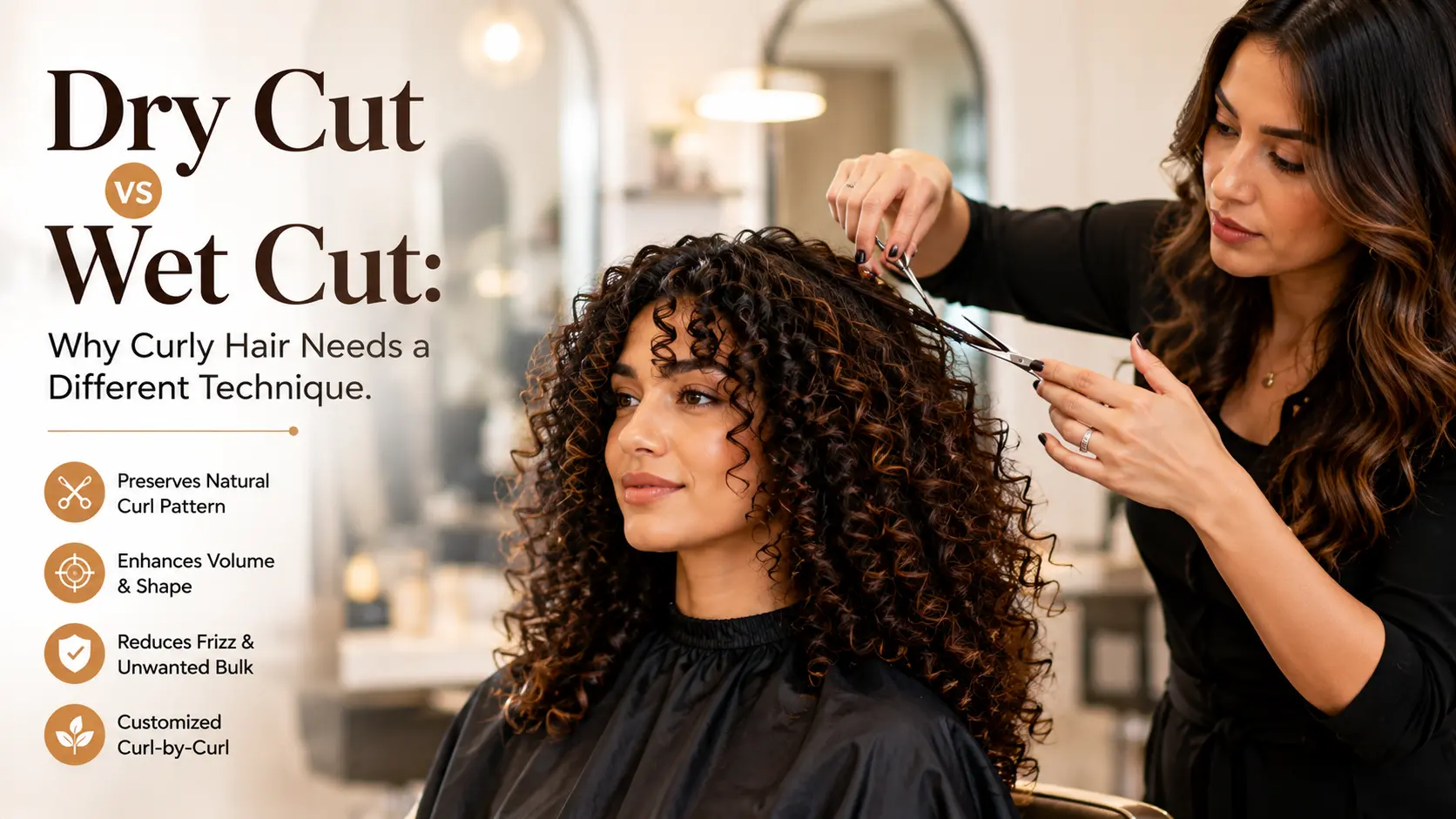
Dry cut for curly hair: Discover Dry Cut vs Wet Cut
Introduction: The Great Curly Hair Misunderstanding
For decades, the standard protocol in hair academies across India and the world was uniform: wash the hair, comb it straight while wet, and cut it into a precise geometric shape. While this works beautifully for straight or slightly wavy hair, for the millions of people with natural curls, this traditional “wet cut” has been the source of countless salon nightmares. We have all seen the result—the dreaded “Triangle Head,” where the top is flat and the bottom pouffs out, or the “Shrinkage Surprise,” where a one-inch trim ends up looking like a five-inch chop once the hair dries.
In 2026, the beauty industry has finally experienced a “Texture Awakening.” We now understand that curly hair is not just “messy straight hair”—it is a unique biological structure that follows its own set of rules. The most significant shift in this revolution is the move away from wet cutting toward a specialized dry cut for curly hair. By cutting the hair in its natural, dry state, stylists can see the exact pattern, spring, and volume of every individual ringlet.
Whether you are a client tired of “settling” for mediocre haircuts or a professional looking to master high-value hair stylist skills, this guide is your ultimate blueprint. We will deconstruct the science of the curl, explain the “Devalook” philosophy, and reveal why a dry cut for curly hair is the only way to achieve consistent, red-carpet-ready results.
Industry Standard: Elite texture clinics and luxury brands like The Salon Company have officially banned wet cutting for Type 3 and Type 4 hair. (Pro Tip: If you are looking for salon jobs that value advanced texture training, the Stylelink app is the premier network to showcase your specialized portfolio).
The Physics of the Ringlet: Why Water Lies
To understand why a dry cut for curly hair is superior, we must look at the science of the hair fiber. Curly hair is inherently asymmetrical. The hair follicle of a curly-haired person is oval or hook-shaped, which causes the hair to twist as it grows. This twist creates “Spring Factor”—the ability of the hair to stretch when wet and snap back when dry.
The Wet Cut Fallacy: When hair is wet, the weight of the water and the tension of the comb stretch the curl out. It becomes an elongated, uniform version of itself. A stylist cutting wet hair is essentially cutting a “lie.” They are creating a shape for a hair texture that only exists for ten minutes while the hair is damp. The moment that moisture evaporates, every curl springs back at a different rate. The result is an uneven, choppy mess that lacks internal structure.
A dry cut for curly hair respects the “Spring Factor.” It allows the stylist to see exactly how much each ringlet will shrink, ensuring the final length is exactly what the client requested.
Wet Cut vs. Dry Cut: The Showdown
| Feature | Traditional Wet Cut | Professional Dry Cut |
|---|---|---|
| Visual Accuracy | Low (Hair is stretched and distorted). | High (What you see is what you get). |
| Length Control | Risky (Extreme shrinkage occurs). | Precise (Length is determined in real-time). |
| Volume Shaping | Guesswork (Hard to see density). | Architectural (Stylist carves out volume). |
| Frizz Factor | Higher (Due to potential cuticle tearing). | Minimal (Respects the hair’s natural seal). |
| Service Time | 45 – 60 Minutes. | 75 – 120 Minutes (Requires more detail). |
The “Devalook” and the Rise of Texture Specialists
The global shift toward the dry cut for curly hair was largely pioneered by the “Devacut” or devalook method. This philosophy treats the head of hair as a sculpture. Instead of sectioning the hair into straight lines, the stylist works curl-by-curl, cutting at an angle that enhances the natural curl pattern. In 2026, this has evolved into even more advanced techniques like the Rezo Cut or the Curl-by-Curl method used at The Salon Company.
These techniques require a completely different set of hair stylist skills. The professional must learn to “read” curls—identifying where the hair needs “internal weight removal” to prevent the triangle shape and where it needs “perimeter density” to look thick and healthy. This is high-level artistry that commands a premium price point in the market.
Top 5 Benefits of a Dry cut for curly hair
If you have curls and haven’t experienced a dry session yet, here is what you are missing:
1. Zero Post-Salon Anxiety
When you get a dry cut for curly hair, there is no “scary reveal” when you get home and wash your hair. Since the hair was cut in its natural state, the shape you see in the salon mirror is the exact shape you will see in your bathroom mirror the next morning.
2. Instant Silhouette Correction
A dry cut allows the stylist to identify the “heavy” spots immediately. They can carve out layers that provide a beautiful, rounded, or tapered silhouette, ensuring the curls stack on top of each other rather than pushing each other outward into a triangle.
3. Healthier Ends
Wet hair is more fragile and prone to snapping. Combing curls while wet and under tension can cause micro-tears in the cuticle. A dry cut for curly hair involves minimal combing and zero tension, preserving the structural integrity of your strands.
4. Custom Face-Framing
Every person has a unique “Curl Profile.” You might have tighter ringlets around your neck and looser waves near your face. A dry cut allows the stylist to treat each section differently, ensuring the curly hair styling perfectly frames your eyes and cheekbones.
5. Long-Lasting Shape
Because the cut is built into the natural pattern of the hair, it grows out much more gracefully. While a wet cut starts looking “off” after four weeks, a high-quality dry cut for curly hair can maintain its shape for three to four months.
Why Expertise is Non-Negotiable: Choose The Salon Company
You must never let a stylist “experiment” with a dry cut on you. It requires a specific set of hair stylist skills that aren’t taught in basic beauty schools. An amateur attempt at a dry cut can leave your hair looking frayed and frizzy.
We strictly recommend booking your appointment at The Salon Company. As a flagship chain within the Stylelink network, they have pioneered the “Texture First” protocol in India:
- Visual Assessment: They analyze your hair dry and unstyled to see your natural volume.
- Ergonomic Cutting: Their stylists are trained to move around the client, cutting each curl at its point of “recoil.”
- Digital History: Using Lokaci Pro software, they log your specific curl type (e.g., 3B with high porosity) so that your future appointments are consistently perfect.
Career Spotlight: The Rise of the Curl Consultant
Are you a hair professional? The market is currently overflowing with fade experts, but “Curl Consultants” are exceptionally rare. If you master the dry cut for curly hair, you are no longer competing on price—you are competing on expertise. Clients with curls are the most loyal demographic in the world; once they find someone who understands their texture, they will never leave.
Here is how the Stylelink ecosystem can elevate your professional journey:
- Find Targeted Salon Jobs: Don’t waste time in salons that don’t respect your specialization. Download the Stylelink App to apply directly for specialized roles at luxury studios and texture-focused brands like The Salon Company.
- Build a Visual Empire: Use Stylelink’s Resume & Portfolio Builder. Upload macro, high-definition videos showing how you transformed a “frizzy triangle” into a bouncy, defined masterpiece. This is the only resume a curl expert needs.
- Business Management: If you run a salon, use Stylelink’s Salon Software (Lokaci Pro) to accurately price your dry-cutting services. Because they take longer than wet cuts, the software ensures your time is billed correctly, protecting your profit margins.
The 3-Step Preparation for a Professional Dry Cut
To get the most out of your dry cut for curly hair, you cannot arrive at the salon with “bed head.” Your stylist needs to see your curls at their best. Follow these steps before your appointment:
1. Arrive with Clean, Dry Hair
Wash your hair the day before or the morning of. It must be 100% dry. Do not apply heavy oils or butters that “weigh down” the pattern. A light leave-in conditioner is acceptable.
2. No Ponytails or Braids
Avoid tying your hair back with an elastic or braiding it. This creates “dents” in the hair and disrupts your natural curl pattern. The stylist needs to see your curls exactly as they fall naturally.
3. De-Tangle Gently
Finger-detangle or use a wide-tooth comb while your hair is still wet after washing. Do not brush your curls once they are dry, as this will create a frizzy cloud that makes it impossible for the stylist to see your ringlets.
Conclusion: Embrace Your Texture
The dry cut for curly hair is more than just a technique; it is a philosophy of acceptance. It is about stopping the fight against your natural biology and starting to work with it. By choosing a cut that respects your unique spring factor and volume, you unlock a level of confidence that a flat-ironed look can never provide.
Do not let another “wet cut” ruin your ringlets. Experience the architectural precision of the texture experts at The Salon Company. And for the ambitious stylists helping the world embrace its natural beauty, download the Stylelink App today to take your career to the elite level. Your curls were meant to bounce—let them!
Frequently Asked Questions (FAQs)
Q1: Is a dry cut for curly hair more expensive than a wet cut?
Yes, usually. A dry cut is a much more detailed, time-consuming process. While a standard cut takes 45 minutes, a curl-by-curl dry cut can take up to 2 hours. You are paying for the stylist’s expertise and time.
Q2: Can I get a dry cut if I have wavy hair (Type 2)?
Absolutely. Even wavy hair has a spring factor. A dry cut ensures that your layers are balanced and that your hair doesn’t look thin at the ends once it air-dries.
Q3: How do I find a stylist who actually knows how to dry cut?
Don’t rely on generic reviews. Use the Stylelink jobs app or website to browse verified portfolios. Look for stylists at premium establishments like The Salon Company who specifically mention texture certifications and dry-cutting methods.
About the Author


